Can You Put Aluminum Foil in an Air Fryer? Everything You Need to Know About Air Fryer Safety
Published on 2026-06-14chuan
Aluminum foil, parchment paper, silicone mats — what is actually safe to put in your air fryer? Complete guide to air fryer accessories with safety rules and tested recommendations.
The Short Answer
Yes, you can put aluminum foil in an air fryer. But — and this is an important but — only if you follow specific safety rules. The biggest risk with foil is not chemical or health-related. It is physical: a loose piece of foil can get sucked up by the air fryer's powerful fan and blown into the heating element, where it can melt, burn, or start a fire. This actually happened to someone I know. They put a small square of foil under their salmon to catch drips, did not weigh it down, and within 30 seconds the foil was pressed against the heating element. The smell of burning aluminum filled their kitchen and the heating element needed to be replaced. The rule is simple: anything you put in the air fryer basket must be heavier than the force of the fan. A piece of foil with a chicken breast on top of it? Fine. A piece of foil by itself? Absolutely not. The same principle applies to parchment paper, which is even lighter and more likely to fly around.
When Foil Is Actually Useful
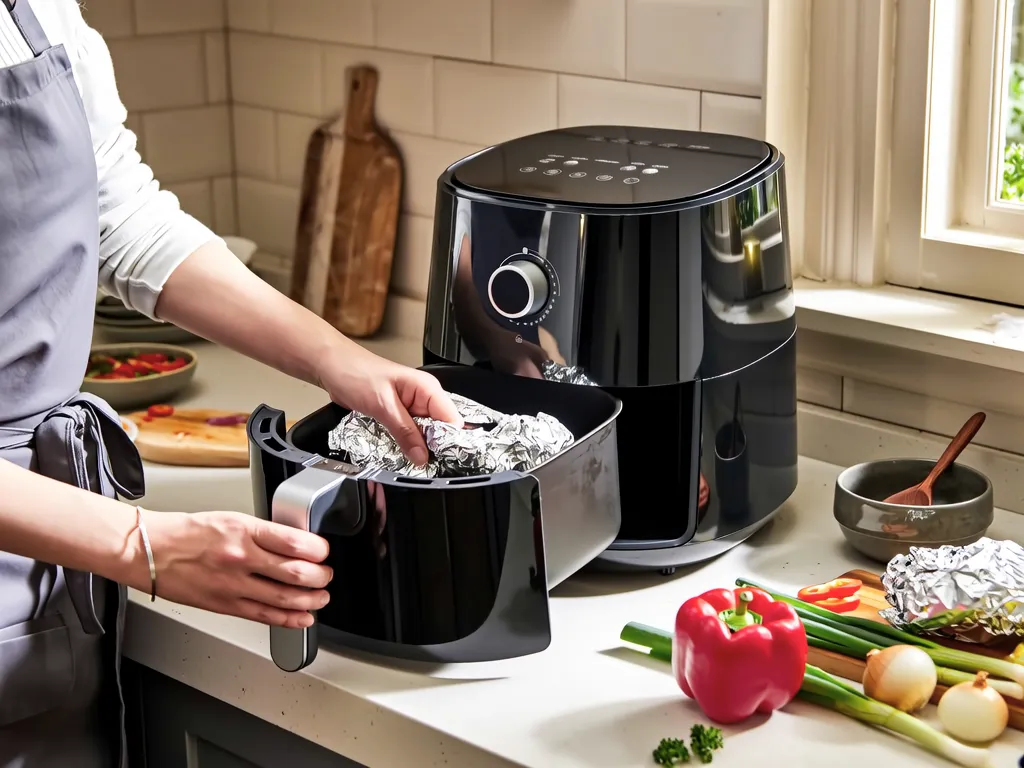
Foil has three legitimate uses in an air fryer. First: catching drips under fatty foods like bacon or sausages. A small sheet of foil in the bottom of the basket — under the food, not under the basket — catches rendered fat and makes cleanup much easier. Second: wrapping foods that you want to steam rather than crisp. Wrapping fish or vegetables in a foil packet with a little liquid creates a steam environment inside the packet, similar to cooking en papillote in an oven. Third: protecting edges of food that are browning too fast. If your chicken breast is getting too dark before the center reaches temperature, a small piece of foil loosely draped over the edges shields them from direct heat while the center finishes cooking. For everyday cooking of most foods, foil is unnecessary. The air fryer's non-stick basket is designed to handle direct food contact, and adding foil can actually reduce airflow around the food, making it less crispy. If you are using foil mainly to avoid cleaning the basket, consider that the trade-off is worse cooking results.
Parchment Paper: Better Than Foil for Most Uses
Pre-cut air fryer parchment paper liners have become popular for good reason. They are heavier than regular parchment paper and come with holes punched in them to allow airflow. The holes are essential — solid parchment blocks the circulation that makes an air fryer work. I use parchment liners regularly when cooking foods that tend to stick, like breaded fish fillets or marinated chicken. The liner prevents sticking without any oil, and cleanup is as simple as throwing away the liner. A few things to know: never preheat with an empty parchment liner in the basket. It will fly up into the heating element. Always put the food on the liner first, then place both in the preheated basket. Also, parchment paper has a temperature limit — usually around 425 to 450 degrees Fahrenheit. Most air fryer cooking falls below this range, but if you are searing at maximum heat, skip the parchment. Regular parchment paper from a roll works fine if you cut it to size and poke holes in it, but the pre-cut liners are more convenient and less likely to have loose edges that can fly up.
Silicone Mats and Liners
Silicone air fryer liners are reusable alternatives to parchment. They sit in the bottom of the basket and can be washed and reused hundreds of times. The advantages: they are heavy enough that they will never fly into the heating element, they provide a reliably non-stick surface, and they reduce waste compared to disposable parchment. The disadvantages: they can block airflow more than parchment because they are thicker and the holes are typically larger but fewer. In my testing, foods cooked on silicone liners come out slightly less crispy on the bottom than foods cooked directly on the basket or on perforated parchment. The difference is small — maybe 5 to 10 percent less crisp — but noticeable in a side-by-side comparison. For foods where bottom crispiness matters (fries, tater tots, breaded items), I skip the silicone liner. For foods where it matters less (salmon, chicken breast, vegetables), the convenience of silicone is worth the small trade-off. Silicone liners are dishwasher safe, which is a real time-saver.
What You Should Never Put in an Air Fryer
Beyond the foil and parchment rules, there are a few things that should absolutely never go in an air fryer. Aerosol cooking sprays: the propellants degrade non-stick coatings. Use a refillable oil sprayer instead. Glass containers that are not labeled oven-safe: air fryers heat up fast and unevenly, which can cause non-tempered glass to shatter. Plastic of any kind: even heat-resistant plastic can warp or melt at air fryer temperatures. Wet batters: as covered in our mistakes guide, they drip through the basket and make a mess. Overfilled containers: if a container blocks more than about half of the basket's airflow, the food on the bottom will steam while the top burns. And the big one: anything that is lighter than the airflow. This includes loose herbs, small pieces of parchment, cheese slices — they will all end up in the heating element. If you hear a flapping sound while the air fryer is running, stop it immediately and check for loose material. That flapping sound is almost always something hitting the fan or heating element.
Accessories That Are Worth Buying
Beyond liners, a few accessories genuinely improve the air fryer experience. A wire rack or second layer rack doubles your cooking capacity by letting you cook on two levels. The food on the top rack will cook faster, so arrange accordingly — quicker-cooking items on top, slower ones on the bottom. Skewer racks let you cook kebabs without them rolling around. Silicone muffin cups are great for baking individual portions. A small oven-safe baking dish lets you make casseroles, dips, and baked pasta in the air fryer. And the most underrated accessory: an oil sprayer. The $10 refillable kind with a pump top. Skip the $40 electric ones — the cheap manual pump sprayers work just as well and last longer. What you do not need: special 'air fryer' cookbooks (the recipes are just regular recipes with adjusted times) and 'air fryer' branded utensils (regular tongs and spatulas work exactly the same).
Putting It All Together: A Safety Checklist
Before you put anything in your air fryer besides food, ask yourself: is it heavier than the fan force? If not, it needs to be weighed down by food. Does it block airflow? If it covers more than half the basket floor, it is going to affect cooking. Is it rated for the temperature? 400 degrees Fahrenheit is the ceiling for most air fryer cooking. Is it food-safe? Not all materials are intended for direct food contact at high temperatures. When in doubt, cook directly on the basket. The non-stick coating is designed for it, and you will get the best airflow and crisping that way. The air fryer is a simple machine — a heating element and a fan — and it works best when you do not overcomplicate things with unnecessary accessories. Understanding these basic safety principles matters more than having every gadget. Use our Food Guide to look up the recommended setup for whatever you are cooking — it tells you whether preheating, oil, or liners are recommended for each specific food.
Frequently Asked Questions
Will aluminum foil damage my air fryer?
Only if it is loose and gets blown into the heating element. When properly weighted down by food, foil is safe to use. Never put empty foil in a preheating air fryer.
Are parchment paper liners reusable?
Most are designed for single use. Silicone liners are the reusable alternative — they cost more upfront but last for years.
Can I use wax paper in an air fryer?
No. Wax paper melts at high temperatures and is not heat-resistant. Use parchment paper or a silicone liner instead.
Want to convert your own recipes? Use our free air fryer calculator.
Air Fryer Calculator