Air Fryer Safety: Food Safety, Fire Prevention, and USDA Guidelines You Need to Know
Published on 2026-05-24chuan
Is your air fryer safe? Complete safety guide covering fire prevention, food safety temperatures, non-stick coating care, and USDA recommendations for air fryer cooking.
What the USDA Actually Says About Air Fryers
The USDA Food Safety and Inspection Service has specific guidance for air fryer cooking. The key points: always use a food thermometer to verify doneness — visual cues like color or clear juices are not reliable indicators that food has reached a safe temperature. Cook in batches if needed to avoid overcrowding, which prevents food from cooking evenly and reaching safe internal temperatures throughout. Do not cook raw, breaded, stuffed chicken products — like frozen chicken cordon bleu or broccoli-stuffed chicken breasts — in an air fryer. These products have been linked to Salmonella outbreaks because the breading can brown before the stuffed center reaches 165 degrees Fahrenheit. Always follow package instructions for these specific products. These are not generic warnings — they are based on actual food safety incidents and USDA research. The air fryer is a safe appliance when used properly, but like any cooking method, it requires attention to food safety fundamentals.
Safe Minimum Internal Temperatures (USDA Standards)
These are the temperatures that food must reach to be safe to eat, according to the USDA. This is not culinary preference — it is food safety science. Poultry — chicken, turkey, duck, whole or ground: 165 degrees Fahrenheit or 74 degrees Celsius. Beef, pork, veal, and lamb steaks, chops, and roasts: 145 degrees Fahrenheit or 63 degrees Celsius with a 3-minute rest time after cooking. Ground meats — beef, pork, veal, lamb: 160 degrees Fahrenheit or 71 degrees Celsius. Fish and shellfish: 145 degrees Fahrenheit or 63 degrees Celsius, or until flesh is opaque and separates easily with a fork. Eggs and egg dishes: 160 degrees Fahrenheit or 71 degrees Celsius. Leftovers and casseroles: 165 degrees Fahrenheit or 74 degrees Celsius. These temperatures apply regardless of cooking method — air fryer, oven, stovetop, or grill. The cooking method does not change the required safe temperature. Check our Food Guide for USDA references specific to each food.
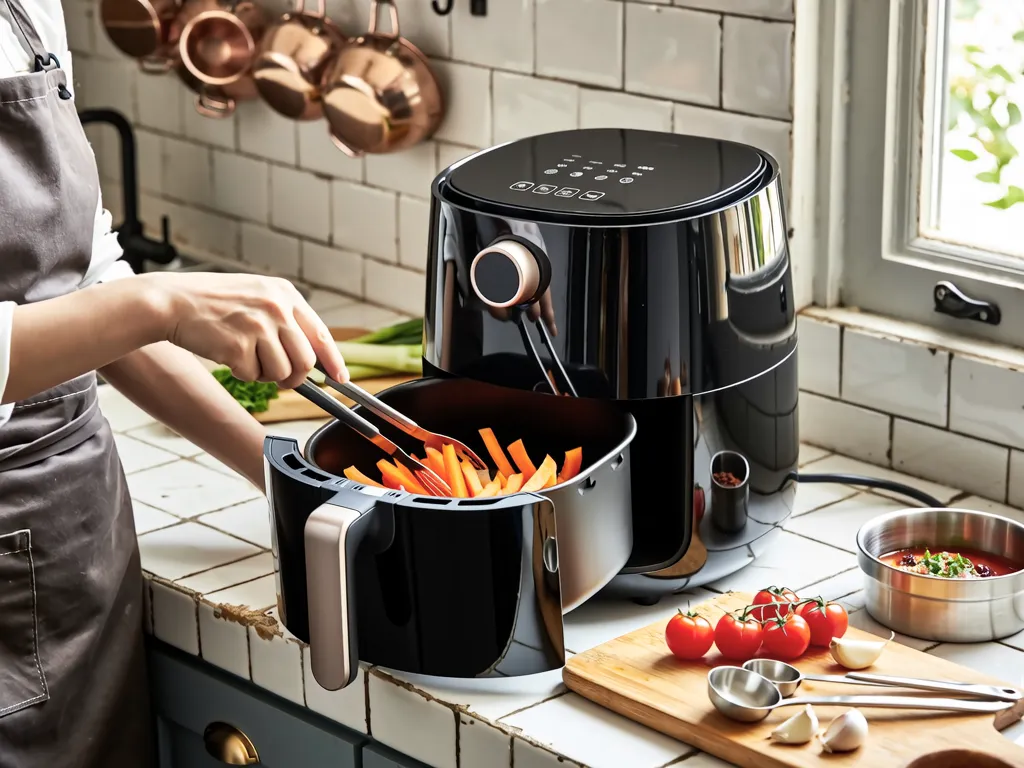
Fire Prevention: What Actually Causes Air Fryer Fires
Air fryer fires are rare but they do happen, and they are almost always caused by one of three things. First: accumulated grease. When fatty foods are cooked repeatedly without cleaning, grease builds up on the heating element and in the bottom of the unit. That grease can eventually ignite when the heating element reaches high temperature. The prevention: clean your air fryer regularly, especially after cooking fatty foods. Wipe down the heating element weekly. Empty and clean the drip tray. Second: loose materials contacting the heating element. Parchment paper, aluminum foil, or food that is light enough to be lifted by the fan can blow into the heating element and ignite. The prevention: always weigh down parchment or foil with food. Never preheat with empty liners in the basket. If you hear flapping sounds, stop the air fryer immediately. Third: leaving the air fryer unattended for long periods. Most recipes take 5 to 20 minutes, so air fryer fires are unlikely to develop undetected, but you should still never leave any cooking appliance running when you leave the house. Stay in or near the kitchen while the air fryer is on. If you see smoke that is not from food grease, unplug the unit immediately. Do not open the basket if you suspect a fire inside — cutting off the oxygen supply by keeping it closed and unplugging is the safest course.
Non-Stick Coating Safety
Most air fryer baskets have a non-stick coating. The safety of non-stick coatings has been the subject of legitimate concern in recent years, specifically around PFAS chemicals — often called forever chemicals — used in some non-stick manufacturing. Most major air fryer brands now use ceramic or PTFE-free non-stick coatings that do not contain PFOA or PFOS, the two most concerning PFAS compounds. Check your air fryer manual or the manufacturer's website for information about the specific coating used. Regardless of the coating type, never use metal utensils on non-stick surfaces — scratches can release coating particles into food and create points where more coating can peel. Never use aerosol cooking sprays — the propellants react with and degrade non-stick surfaces over time. If your basket's coating is visibly peeling, flaking, or deeply scratched, replace the basket. Continuing to use a damaged non-stick surface risks ingesting coating fragments.
Electrical and Placement Safety
Air fryers draw significant power — typically 1400 to 1800 watts. Plug them directly into a wall outlet, not into an extension cord or power strip. Extension cords may not be rated for the sustained high draw of an air fryer and can overheat. Place the air fryer on a heat-resistant surface with at least 5 inches of clearance on all sides. The exhaust vent at the back blows hot, sometimes greasy air, and it can discolor or damage walls, backsplashes, and cabinets over time. Never place an air fryer on a stove — accidentally turning on the burner is a well-documented cause of air fryer fires. Keep the power cord away from the edge of the counter where it could be snagged or pulled. And never immerse the main unit in water — it contains electrical components. Only the removable basket and tray are washable.
Using a Food Thermometer Correctly
The USDA emphasizes that a food thermometer is the only reliable way to know if food has reached a safe temperature. Insert the thermometer into the thickest part of the food, avoiding bone, fat, and gristle. For thin items like chicken breasts or burgers, insert the thermometer from the side to get the sensor into the center of the food. For irregularly shaped items, take readings in multiple locations. Clean the thermometer probe with hot soapy water between readings to prevent cross-contamination between raw and cooked foods. Digital instant-read thermometers are the most practical for air fryer use — they give a reading in 2 to 3 seconds and are thin enough to insert into most foods without creating a large puncture. For every food in our database, we include the USDA safe minimum internal temperature.
Frequently Asked Questions
Can an air fryer catch fire?
It is rare but possible, usually from accumulated grease on the heating element or loose material contacting the element. Regular cleaning and always weighing down parchment or foil with food prevents most fire risks.
Is the non-stick coating on air fryers safe?
Modern air fryers from major brands use PFOA-free and PFOS-free coatings. Avoid metal utensils and aerosol sprays to prevent coating damage. Replace the basket if the coating is peeling.
Is it safe to cook raw meat in an air fryer?
Yes, as long as the meat reaches the USDA safe minimum internal temperature. Use a food thermometer to verify — poultry 165 degrees Fahrenheit, beef and pork steaks 145 degrees, ground meats 160 degrees.
References & Sources
Want to convert your own recipes? Use our free air fryer calculator.
Air Fryer Calculator