Air Fryer Beginner's Guide 2026: Everything I Wish I Knew on Day One
Published on 2026-05-20chuan
Just got an air fryer? Start here. Everything a beginner needs to know — first cook, must-try foods, essential settings, cleaning routine, and the mistakes to avoid from the start.
What I Wish Someone Had Told Me on Day One
I bought my first air fryer on a whim during a sale. I unboxed it, glanced at the manual — nobody reads the manual — threw in some frozen fries, set it to 400 degrees, and waited. The fries came out okay. Not great, but okay. For the next two weeks, I cooked everything at 400 degrees because I assumed that was how air fryers worked. Some things came out good. Some came out burnt on the outside and raw inside. I did not clean the basket for the first week because it did not look dirty. When I finally did cook bacon, the accumulated grease started smoking and set off the smoke alarm at 7pm on a Tuesday. I made all the beginner mistakes so you do not have to. Here is what I would tell myself if I could go back, organized as a practical first-week guide for new air fryer owners.
Unboxing and First Setup
When you open the box, wash the basket and tray with warm soapy water before using them. There can be manufacturing residue or dust from the factory. Dry them thoroughly. Then run the air fryer empty at 400 degrees for about 10 minutes. This burns off any protective coatings or oils from manufacturing. You may notice a slight plastic smell during this first empty run — that is normal and it will not happen again. Place the air fryer on a heat-resistant countertop surface with at least 5 inches of clearance behind it for the exhaust vent. Do not put it under cabinets — the hot air from the vent can damage cabinet bottoms over time. Do not put it on the stove. Just do not. If you have laminate countertops, put a silicone mat or cutting board under the air fryer for heat protection. Now you are set up and ready to cook.
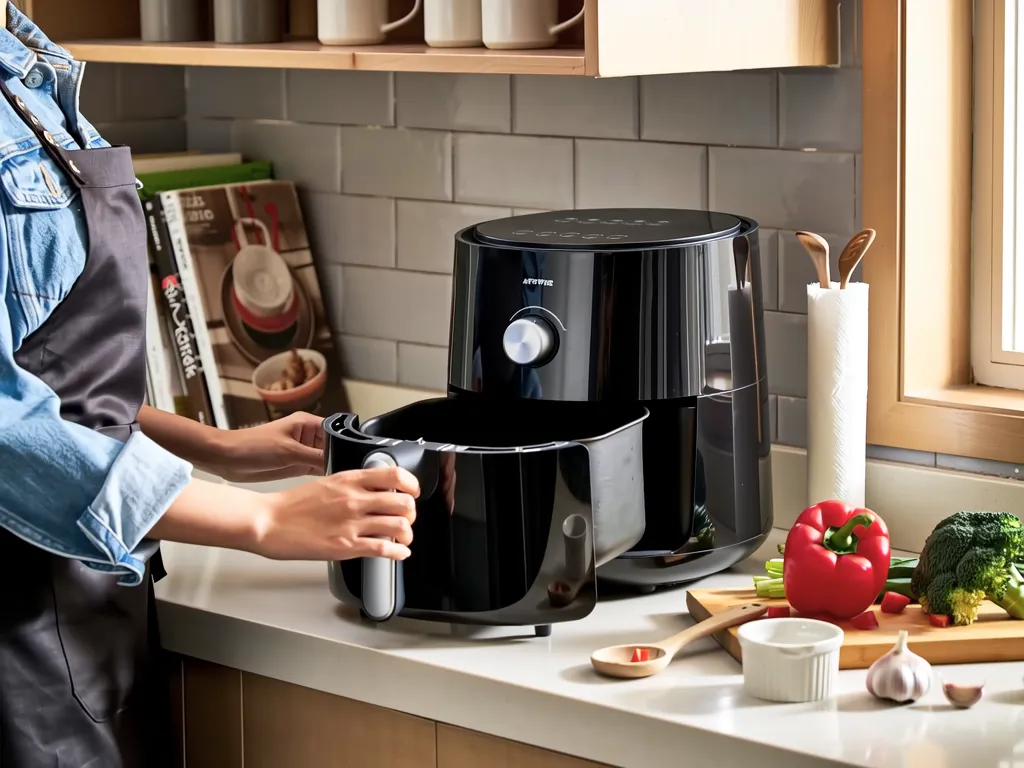
Your First Cook: Frozen French Fries
French fries are the ideal first cook because they are forgiving, the results are immediately impressive, and they teach you the core techniques: single layer, preheat, shake halfway, season after cooking. Set the temperature to 400 degrees Fahrenheit. Preheat for 3 minutes. While preheating, take your frozen fries out of the freezer. You want them to stay frozen — do not let them thaw. When the air fryer is preheated, pour the fries into the basket. Fill it no more than halfway. If you have a full bag, cook half now and half in a second batch. Spread the fries into a single layer. If you want extra-crispy fries, spray lightly with oil — optional but recommended. Cook for 5 minutes. Open the basket and shake it vigorously — the fries should tumble and rearrange. Cook for another 5 to 8 minutes until golden brown and crispy. Immediately transfer to a bowl, add salt while the fries are still hot and slightly oily, and toss. Eat immediately — air fryer fries lose crispiness as they cool. That is it. If these fries come out crispy and golden, your air fryer works and you have mastered the basic technique. If they are not crispy, refer back to the troubleshooting step below.
The Five Essential Settings to Know
You do not need to understand every button on your air fryer. Here are the only five things you need to set for any cook. Temperature: controlled with plus and minus buttons or a dial. Set this before time so the preheat starts. Time: also plus and minus or dial. Start with less time than you think — you can always add more, but you cannot un-burn food. Preheat: your air fryer probably has a preheat button or preheats automatically when you set temperature and press start. If not, just run it empty at your target temperature for 3 minutes. Shake reminder: many models beep halfway through the cooking time to remind you to shake or flip. Use this feature if you have it — it is genuinely helpful. Power off: the air fryer will beep when the timer ends and stop heating. Some models switch to a keep-warm mode. If you are not eating immediately, take the food out anyway — it will continue to cook from residual heat if left in a hot basket. That covers 95 percent of what you will ever need to do with your air fryer. The preset buttons — fries, chicken, fish, bake, reheat — are just programmed combinations of temperature and time. You can achieve the same result by setting the temperature and time manually.
The First Week: What to Cook and in What Order
Here is a suggested progression for your first week of air fryer cooking, designed to build skills gradually. Day 1: frozen french fries. Learn preheating, single layer, shaking, seasoning. Day 2: frozen chicken nuggets or tenders. Same technique as fries but slightly longer cook time. Day 3: fresh chicken breast. First cook of raw meat. Learn to use a thermometer — this is the day you understand why temperature matters. Day 4: fresh vegetables — broccoli or Brussels sprouts. Learn how vegetables caramelize differently than proteins. Day 5: bacon. Learn about cold start versus preheat — bacon starts cold to render more fat. Day 6: salmon. First cook of fish. Learn how delicate proteins need less time and lower temperature than chicken. Day 7: reheat leftovers from the week. Learn reheating temperatures and times. By day 7, you will have cooked protein, vegetables, frozen food, and reheated all in one week, and you will have developed an intuition for your specific model.
If Something Goes Wrong
Here is the quick troubleshooting guide for the most common beginner problems. Food not crispy: basket too full, no preheat, food was wet going in, or no oil. Fix: single layer, preheat 3 minutes, pat food dry, light oil spray. Food burnt outside and raw inside: temperature too high for the thickness of the food. Fix: lower temperature by 25 degrees, cook slightly longer. Smoking during cooking: grease buildup on the heating element or fatty food rendering fat. Fix for grease: clean the heating element when cool. Fix for fatty food: put a small piece of bread under the basket tray to absorb dripping fat. Food sticking to basket: insufficient oil or basket needs cleaning. Fix: light oil spray on basket before adding food. Baked goods not rising: temperature too high, top setting before leavening works. Fix: lower temperature to 320, cover with foil for first half of baking. For more specific guidance, our Time Finder on the homepage gives you tested temperatures and times for 50-plus foods with adjustment options.
Frequently Asked Questions
Do I need to preheat every time?
For most foods, yes — 3 minutes of preheating improves results noticeably. The exceptions: bacon and other very fatty foods that benefit from a cold start to render more fat.
How do I know when my food is done?
For meat, use a food thermometer — it is the only reliable method. For vegetables and frozen foods, visual cues work: golden brown and crispy exterior. Always check 2 to 3 minutes before the maximum recommended time.
Can I open the basket during cooking to check?
Yes. The air fryer will pause when you open the basket and resume when you close it. Opening briefly to check or shake food is expected and will not ruin your cook.
Want to convert your own recipes? Use our free air fryer calculator.
Air Fryer Calculator